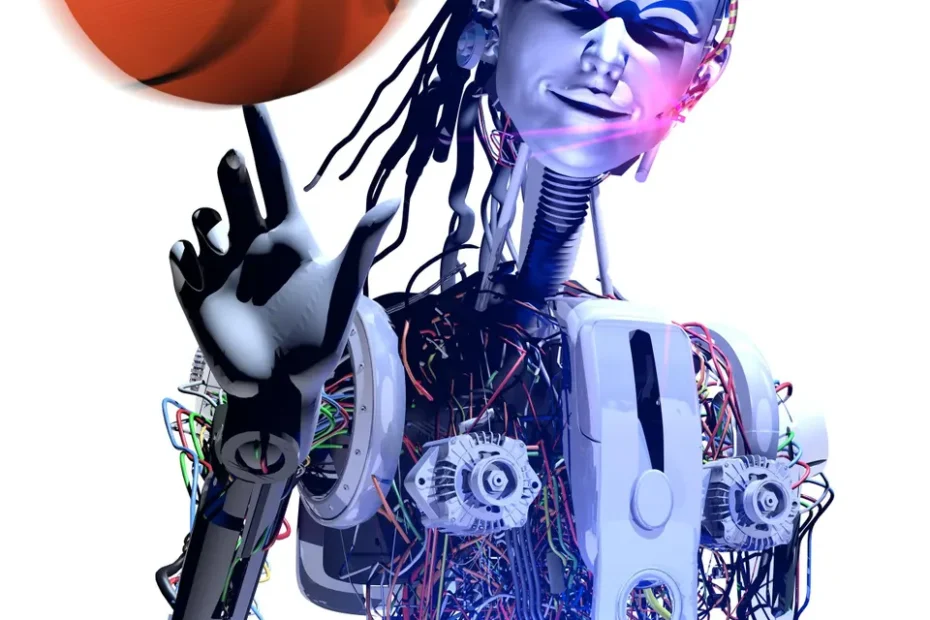
Artificial Intelligence or “AI” may soon run high school sports. It may even generate an AI-inspired basketball team. Lets review the origin of an AI-inspired basketball team.
The premise would eliminate human interaction with coaches or referees. It leaves software applications, hardware, cameras, audio, video, and algorithms for determining team members, running practice, and in-game coaching. Lets see how it would work.
The most important piece is the algorithm, which broadly provides a step-by-step procedure for accomplishing some end or solving a problem.
First would be tryouts and selecting the team. Kids gets shirts with numbers on them. Tryouts would be a video/Zoom led set of drills for 2-hours over three days. Participants would wear earbuds for instruction and a video broadcast on four walls of the gym would demonstrate the drill. It would be performed for two-minutes (which is a long time to do the same thing repetitively). Before a new drill is introduced in the same way. A web camera records the players’ drill proficiency.
It can be broken down by stations with a cohort of players being the same size, year, and skill level doing drills together. Then move to another station drill when time is up. The drills comprise shooting, passing, running, defending, rebounding, and 5-minutes or so of full court play. Figure in four-minute breaks every 30-minutes with three breaks over 2-hours.
A software program/algorithm deciphers the video from the 3-day try-out performance. Each player is evaluated on +1 or -1 basis for sufficiency(+1), insufficiency(-1), turnovers(-1), drops(-1), made passes(+1), made baskets(+1), and the like. The top 12 performers are offered spots on the high school AI-inspired basketball team. A chatbot like Claude will instant message (IM) the selected students. The team is formed.
There’s still no human coach, so dissatisfied parents can IM Claude and begin a web-based chat session for a download of the tryout scoring rubric and video compilation of their child’s performance. Essentially they can see for themselves, as its all recorded and assessed for proficiency.
Next up are practices and game preparation. These too are AI-devised and lead. Two-hour practices are intentional by concentrating on deficient skill sets and preparing a strategy for the next opponent. Claude runs this too. In the same way that tryouts were run. Claude is used to scout opponents and devise the best game-day approach. Practices are recorded with a similar scoring system and starters are declared for the first game. Like tryouts, dissatisfied parents can IM Claude for a chat session, where backup video and metrics are available for review.
Once the contest begins, real-time metrics and performance determine playing time, substitutions, etc. Claude also tracks biometrics for each player. So if someone is dehydrated, hurt, has a head ache, gassed, high body temperature, making mistakes, Claude determines the substitution pattern in real time. Simultaneously via ear buds the tired player is told to substitute out and a bench player reports into the game.
Statistics from the last game and upcoming practice sessions determine the next starting group. Claude scouts the next opponent and devises the best approach.
Just like in baseball, an automated ball/strike system or ABS-type system would replace referees and call the basketball game. Information would be transmitted via ear buds. There is no arguing with a machine. It should lessen fan outbursts too. There are no coaches, so that dispute source is absent.
The game and practice instructions run on everyone’s phone. Players can go home and practice what is expected. Hopefully players improve with repetition and instruction. During games players have their phones on the bench to follow the AI-lead game plan and instructions. This might include who to guard, out-of-bounds plays and the like. Claude makes the analysis and sends instructions to everyone’s phone. The phone goes under the chair, when playing on the court.
Claude-like instructions on defense might resemble Apple Maps – “slide left, beat opponent to baseline, prevent a pass, don’t foul.” On offense – “cut hard changing foot speed and direction, receive a pass from teammate, get into a triple threat position, pass fake, shot fake, two hard dribbles right, and take a mid-range jump shot.” It informs players of mistakes and steps for correction. Similarly, Claude provides encouragement and praise for good and great play leading to success.
All in all its each players ability to execute those AI instruction that determine their success. An AI program decides competency in real time, not a human coach.
Malcolm Gladwell describes this ability to execute a “capitalization rate.” The percentage of people in any given situation who have the ability to make the most of their potential. So its a two-pronged approach with Claude knowing and providing what to do; and players who know and are able to bring their best performance to the game. It will no longer be coaches involved with this instruction, but AI.
Under this AI model, basketball decisions are all based on indisputable factual evidence and metrics. This eliminates claims of coaches favoritism, personality conflicts, someone doesn’t like my kid, and any number of other wild claims that parents conjure.
Neil Sahota authored an article in Forbes, Slam Dunk Technology: How AI is Revolutionizing Basketball (March 26, 2024), which cites the use of AI for fan experiences and business operations. Data analytics, scouting and recruitment are well known uses of AI and advanced in this Post. Enhanced fan engagement offers personalized content to friends and family, making them feel more connected to their team and players. AI and it algorithms are also being used in optimize marketing strategies and ticket sales.
Under this model, the whole season proceeds with Claude in charge of all facets of a high school program, an AI-inspired basketball team. This model replaces coaches with final decisions made by Claude, who is now the expert machine. It can be deduced that AI pushes the human performance capitalization rate to the maximum, to the boundaries of human potential. Claudette, you go girl!

From Alan Parson Project, I Robot

From Getty in Forbes